Kitty Meow: A Playful Display Font That Builds Brand Charm
As a small business owner who designs every label, posts every Instagram story, and hand-illustrates every thank-you card, I know how much a single typeface can shape how customers see my brand—not just in style, but in trust. That’s why Kitty Meow quickly became one of my go-to display fonts. It’s not just “cute.” It’s intentionally warm, gently bouncy, and full of personality—without sacrificing clarity or versatility.
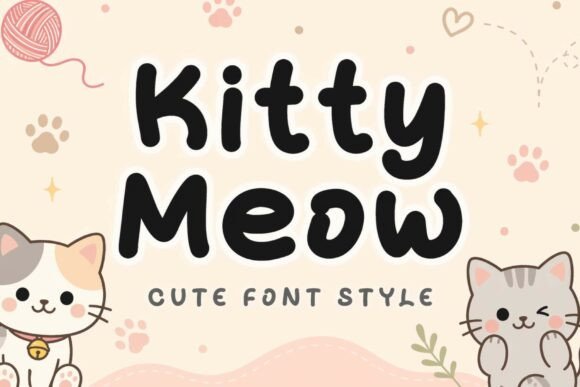
Kitty Meow is a playful display font with soft curves, friendly proportions, and subtle whimsy. Think of it as the visual equivalent of a cheerful wave or a handwritten note tucked into a gift box. It includes full uppercase and lowercase sets, numerals, punctuation, and multilingual support—so whether you’re labeling lavender-scented soy candles for EU customers or designing bilingual signage for your neighborhood café, you won’t hit a dead end.
I first used Kitty Meow on the logo for my handmade soap line—and instantly noticed how it softened the overall impression. Before, the branding felt polished but distant. With Kitty Meow as the wordmark, it felt approachable, human, and memorable. Customers started tagging us in unboxing photos saying things like *“That font made me smile before I even smelled the soap!”* That kind of emotional resonance isn’t accidental—it’s intentional typography at work.
Here’s where Kitty Meow shines across real business touchpoints:
- Logos & wordmarks: Use it as your primary brand name—especially if your business leans into warmth, playfulness, or care (think: children’s boutiques, pet services, wellness studios, or indie bakeries).
- Packaging & product labels: Its clean letterforms hold up beautifully at small sizes—on 2-inch candle stickers or 3-ounce skincare jars—without losing legibility.
- Social media graphics: On Instagram carousels or Pinterest pins, Kitty Meow draws attention without competing with your imagery. Try it for headlines, limited-time offers, or seasonal banners (“Spring Sale!” or “New Batch Just Dropped!”).
- Menus & printed collateral: A local café I consulted for swapped their generic sans serif for Kitty Meow on their chalkboard-style menu headers—and saw more engagement from families and young professionals alike.
- Website banners & email headers: Used sparingly (never for body text), it adds instant character to hero sections, newsletter subject lines, or limited-edition launch announcements.
Consistency matters—especially when you’re building recognition across platforms. Using Kitty Meow as your signature display font helps unify everything from your Etsy shop banner to your packaging tape stamp to your weekly Instagram Story highlight cover. When customers see that same gentle bounce in your logo, your sticker, and your holiday card, they begin to recognize your voice—not just your name.
But here’s something practical I learned the hard way: never commit to a font across all assets before testing it in context. I recommend downloading Kitty Meow and running three quick checks before finalizing anything:
- Print a sample label at actual size—does it stay clear on matte kraft paper or glossy sticker stock?
- Preview it on your phone screen—does the spacing hold up in a 400px-wide Instagram Story?
- Test it alongside your body font—does the contrast feel balanced, not jarring?
Speaking of pairing: Kitty Meow works best as an accent or headline font—not for paragraphs. Pair it thoughtfully. For example:
- With a clean, neutral sans serif (like Inter, Poppins, or Montserrat) for balance—ideal for product descriptions, website copy, or business cards.
- With a relaxed serif (like Merriweather or Lora) for artisanal or heritage-leaning brands—great for boutique packaging or print brochures.
- Avoid pairing it with other decorative fonts—two playful typefaces compete instead of complement.
Readability is non-negotiable—even in a fun font. Kitty Meow was designed with generous x-height and open counters, so letters like “a,” “e,” and “s” remain distinct even at smaller sizes. That means your “50% Off” tag stays scannable on a shelf, your “Gluten-Free” badge reads clearly on a cookie bag, and your “Thank You!” sticker doesn’t require squinting.
One thing I always double-check before using any font commercially? The license. Kitty Meow is a premium display font, and its commercial license covers use in logos, packaging, digital ads, social graphics, and client work—yes, even on physical products you sell. But always verify the specific terms before adding it to templates you resell or embedding it in apps or web fonts for public use.
For entrepreneurs building brands by hand—whether you're stitching embroidery kits, roasting small-batch coffee, teaching online yoga classes, or launching a plant-based skincare line—your typography is part of your service. It tells people what to expect before they click, buy, or walk through your door. Kitty Meow doesn’t shout. It invites. It connects. And most importantly, it helps your small business look like the thoughtful, consistent, and genuinely human presence you’ve worked so hard to become.
So next time you’re updating your product label, refreshing your website banner, or sketching your first logo draft—give Kitty Meow a try. Not because it’s trendy, but because it makes your brand feel like home.